
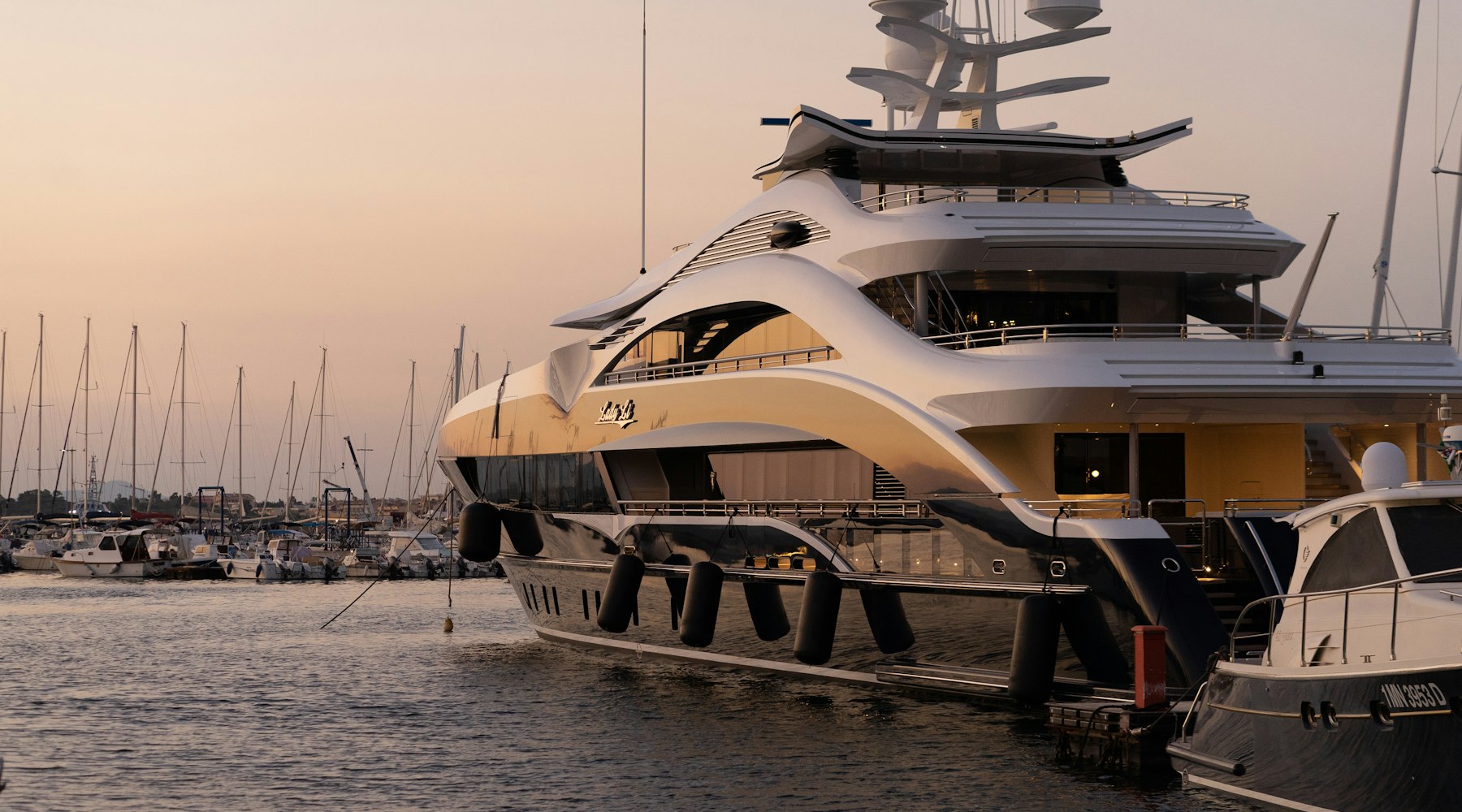
Short answer: Digital marketing for yacht sales is built on the understanding that buyers go through a long and quiet research process. The decision takes months, not weeks, so the first contact aims for trust rather than a sale: technical specifications, real photos and transparent condition information. Rebel Co. Group structures a listings page not as a catalog but as a portfolio where every boat has its own page.
Yacht sales fit none of the patterns digital marketing is used to. The product is expensive, the number of buyers is small, the decision takes months and the sale usually closes not on a screen but at a table. That is why anyone entering this sector expecting to "run ads and get sales" ends up disappointed. On the other hand, the seller who positions digital correctly gains an advantage competitors cannot see.
The foundation: Turkey holds a strong position in this market
Turkey's ship and yacht sector exports reached an all-time high of 2 billion 243 million dollars in 2025. In the first four months of 2026, exports rose to 932 million dollars, an increase of 103.8 percent compared with the same period last year. Looking at the historical trend, the sector was at around 1 billion dollars in 2018 and 2019, passed 1 billion 453 million dollars in 2022 and reached 1 billion 912 million dollars in 2024. Today Turkey ranks second in the world in superyacht production.
These figures are the raw material of a marketing story. If international buyers still know Turkey for its price advantage, that is a communication gap. When production capacity and the quality ranking are this clear, positioning on price means giving up margin voluntarily.
Who the buyer is and how the sales cycle works
In this segment, buyers run most of the purchase process without contacting the seller. They research, compare, consult their circle and only get in touch after reaching a certain level of clarity. This changes the role of your digital presence: persuasion starts long before the first meeting.
- Research stage: International yacht listing platforms, search engines, industry publications and, increasingly, AI chat interfaces.
- Shortlist stage: This is where the shipyard's or broker's own digital presence comes in. A weak website is a reason to be dropped from the shortlist.
- Contact stage: The broker relationship becomes decisive. Digital does not sell here, it prepares.
- Decision stage: Technical verification, reference deliveries and assurance of after-sales service.
Reputation: the real currency of this segment
In high-value, long-cycle sales, the buyer's biggest fear is not overpaying but entering a long process with the wrong party. That is why reputation signals are more decisive than creative quality.
- Reference deliveries and real project records. Proof, not visuals.
- Technical transparency: Clear information about dimensions, materials, certification and the delivery process.
- After-sales: Maintenance, service network and warranty coverage are often discussed as much as the product itself.
- Corporate continuity: Buyers want to be convinced they will still have someone to talk to five years from now.
We covered how these signals are built at the brand level in our brand positioning guide. In his article on AI in the luxury sector, Sefa Aydın discusses where AI can be used in the luxury segment and where it damages the brand.
International visibility
Your buyer is most likely outside Turkey and most likely searching in English. This is not just a matter of building a multilingual website. You need to account for how target markets search, the terminology used in those markets and presenting technical specifications in the units those markets understand.
On top of this comes a new layer: visibility in AI interfaces. We detailed this layer with a sector example in our article on AI visibility. Which names come up when a buyer asks about "superyacht builders in Turkey" is now something you can measure and influence. We cover this area in our AI visibility service.
Lead qualification: fewer but the right ones
In this segment, getting many leads is not a sign of success. On the contrary, unqualified leads eat up your sales team's most expensive time. The goal of your campaign setup is not to multiply leads but to filter for the right ones.
- The content itself should filter: technical depth naturally screens out casual interest.
- Form length is a deliberate tool: in this segment a short form is not always better.
- Source tracking: you cannot allocate budget without knowing which channel actually produces leads that turn into conversations.
Measurement
In a business with only a few sales a year, looking at a monthly conversion rate is meaningless. The meaningful chain in this segment is: the number of qualified conversations, the rate of conversion to an offer, the length of the sales cycle and the total acquisition cost of a sale. Every budget decision made without these metrics is a guess. We explained how to build this metric chain in our ROAS guide.
In this segment, the job of digital is not to close the sale but to make sure that when a buyer researches you, they find a serious party. Closing always remains a human job.
If you want to build your international visibility, talk to Rebel Co. Group. Related services: yacht marketing agency, brand strategy, SEO consulting and video and production.
Frequently asked questions
Does digital marketing really work for yacht sales?
It works not as a tool for closing sales directly but as a tool for generating demand and building reputation. In this segment buyers make their decision over months, mostly through a broker relationship. The task of digital is to be there the moment a buyer starts researching and to nurture trust throughout the process.
Where do yacht buyers do their research?
Research starts on international yacht listing platforms, search engines and, increasingly, AI chat interfaces. Industry publications, boat shows and the broker network add to this. A seller who depends on a single channel misses most of the buyer's research.
How do you position a yacht built in Turkey in the international market?
Turkey ranks second in the world in superyacht production, and sector exports hit a record 2 billion 243 million dollars in 2025. This is a foundation that makes it possible to position on quality and capacity rather than price. Production expertise, reference deliveries and after-sales service should sit at the center of your communication.
Which metrics should you track in this segment?
Clicks or form counts are misleading. The meaningful metrics are the number of qualified conversations with a verified budget, the rate of moving from first contact to an offer, the length of the sales cycle and the total acquisition cost of a sale.